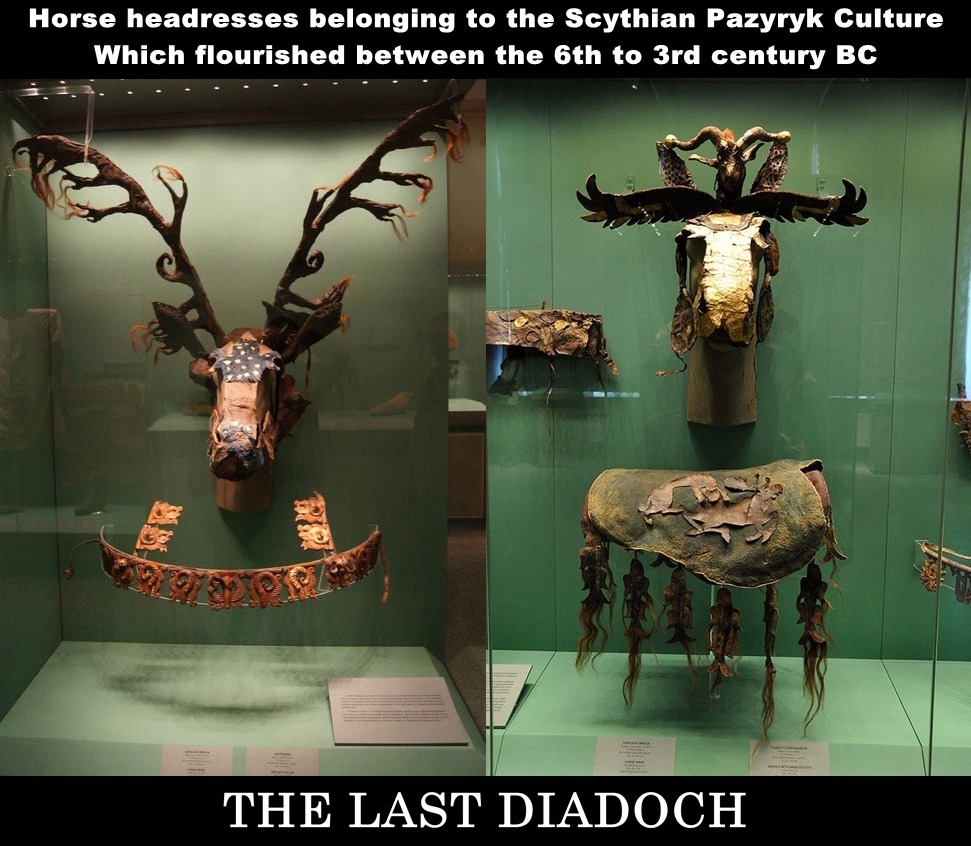
“-a remarkable mask and breast collar for a horse, from around the 3rd-4th century B.C., from the Pazyryk culture of the Altai – a region in central Siberia”
“Pazyryk is the name of an ancient people who used the stone covered
burial mound or “kurgan” typical of Scythian, Sarmatian, and the
Siberian Pazyryk cultures. Pazyryk is the location of a chain of 26 such kurgans
covering about a half mile.”
Horse mask in form of
deer antlers. Pazyryk barrow no. 1, 305-288 BCE
“Beginning in the 1920s, archaeologists excavating the Pazyryk burial mounds
have found the embalmed body of a tattooed man from c. 300-290 B.C.,
textiles, wagons, horses, bridles, saddles, and more artifacts, preserved by
having been frozen.
Xavier Jordana, of Spain’s Universitat Auto’noma de Barcelona, led a 2-year
study of the Pazyryk burial mounds that examined the causes of death of 10
individuals. Jordana says half the sample died violently, either in battle or
as sacrificial victims, and there seems to have been an effort at scalping.”
Some of the best examples of Iron Age tattoos belong to the Pazyryk culture,
the Siberian Ice Maiden being one of the more famous ones.
“The sample consists of 10 individuals,
comprising seven adult males, one adult female and two children. Seven
individuals exhibited a total of 14 traumatic injuries. Six of these injuries
(43%) showed evidence of bone remodeling and eight injuries (57%) were morphologically
compatible with a perimortem origin.”
“Twelve injuries (86%) were related to interpersonal violence, most likely caused by weapons similar to those found in Pazyryk tombs (battle-axes, daggers and arrowheads). Five individuals, including the female and one child, exhibited evidence of violent death. Furthermore, one individual also exhibited evidence of scalping.
Despite the small number of Pazyryk skeletons analyzed, the pattern of traumatic injuries observed appears to be in agreement with that documented in conflicts related to raids or surprise attacks, and not a result of routinized or ritualized violence. These findings contribute new data to osteological evidence from Scythian burial sites.”
Pazyryk burials site
Drawing of section of Pazyryk Barrow no. 5. 252-238 BC
Buried horses,
saddles are among some of the things buried in these kurgans.
“These finds were preserved when water seeped into the tombs in antiquity and
froze, encasing the burial goods in ice, which remained frozen in the
permafrost until the time of their excavation.”
A landmark climate-change lawsuit brought by young people against the US government can proceed, the Supreme Court said on 2 November. The case, Juliana v. United States, had been scheduled to begin trial on 29 October in Eugene, Oregon, in a federal district court. But those plans were scrapped last month after President Donald Trump’s administration asked the Supreme Court to intervene and dismiss the case.
The plaintiffs, who include 21 people ranging in age from 11 to 22, allege that the government has violated their constitutional rights to life, liberty and property by failing to prevent dangerous climate change. They are asking the district court to order the federal government to prepare a plan that will ensure the level of carbon dioxide in the atmosphere falls below 350 parts per million by 2100, down from an average of 405 parts per million in 2017.
By contrast, the US Department of Justice argues that “there is no right to ‘a climate system capable of sustaining human life’” — as the Juliana plaintiffs assert.
Bear forever in mind that this is a conservative government, a Republican government, arguing that no one has the right to a livable planet.




















 DEEP WORLD SEA